Our new book chapter describes how Scientific Microservices data scientists found the same answer as an Olympic expert panel - two years earlier and for one percent of the price.
Where to put the main stadium for the Olympics?
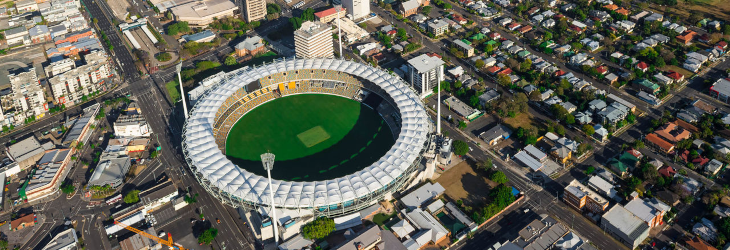
The question of where to host the Brisbane 2032 Olympics - specifically, the choice of main stadium - has been one of the most inflammatory issues in recent news here in my part of Australia.
Like most cities, Brisbane doesn’t have an Olympics-ready stadium. One of our existing stadiums would need to be upgraded - but which one?
Initial discussions favoured the beloved Brisbane Cricket Ground in inner Brisbane (“the Gabba”). But renovating the Gabba would disrupt the inner city and demolish an existing school for primary-age children.
The question inflamed the passions of sports enthusiasts and community defenders, culminating in protests, political infighting, and uncertainty.
In March 2024, after a Queensland Government-funded independent Sport Venue Review for the Brisbane Olympic and Paralympic Games, the ideal solution was reached.
The Government announced that the Brisbane Olympics will combine upgrades to the Queensland Sports and Athletics Centre (QSAC) as an athletics venue, and to Suncorp Stadium as a venue for the Opening and Closing ceremonies. This recommendation was reached after 900 submissions, 130 meetings, and 28 site visits.
I’m happy to report that we beat them to it. By a mile. This is the same conclusion that we reached in our report to the QUT Centre for Future Enterprise in January 2022, more than 2 years earlier.
Two years earlier and 1% of the cost
Our budget for that analysis was just under $20,000 AUD.
That’s a savings of - actually, I can’t calculate it, as I can’t find a line item budget for the Sport Venue Review anywhere. It troubles me a bit that it’s so difficult to find out how much our Government spends on advice. I guess that’s a topic for a different newsletter.
But, I can find the amount spent on proposals and pre-work for the development of the stadium that was originally proposed.
Research on the Gabba stadium, in East Brisbane, cost the Queensland government $6.4 million AUD. That’s not including the extra cost of the independent Sport Venue Review.
Taking that $6.4 million as a conservative figure, then, our project came in with the same results for less than 1% of the cost.
How did we do it?
Instead of long-winded and expensive panels, we used scientific inductive reasoning and data.
Looking at the criteria for the Brisbane Olympics - “bang for buck” per Queensland Premier Steven Miles - gave us the core metric we needed to consider: cost.
By gathering and preparing data from previous Olympic games, and selecting the correct spatial statistical models, we could predict the likely cost overrun for different stadiums.
We found that stadiums were more expensive to bring up to Olympic standards if they were older and closer to the centre of the city. We also considered the distance to public transport, the surrounding area available to lay-down construction equipment during building, and space for athletes to warm up during the Games.
We found that QSAC had the best “bang for buck”, due to its size, newness, and position relative to public transport. We also recommended striking a balance between stadiums, using one “iconic” inner-city stadium for the Opening and Closing Ceremonies and using QSAC for the athletics events.
These were the exact same findings that the Sport Venue Review eventually reached two years later.
The confidence of a decision well made
I’m glad that the Sport Venue Review finally came around to our conclusion. According to our analysis, using the Gabba for the Brisbane 2032 Olympics would have meant a predicted overall Olympics cost of $20.76 billion USD: five times the amount that’s been budgeted. It’s reassuring to know that the Queensland Government is basing its decisions on evidence, even if they could have discovered these answers much earlier and for much less expense.
It gives us hope that the Brisbane Olympics really could be delivered with maximum “bang for buck”. It will have to be: the budgeted amount for the Brisbane Olympics is $4.45 billion USD, which is less than any Olympic Games has cost since the Cold War. If they keep making sensible decisions driven by data, the Queensland Government has a good chance of delivering on these promises.
At Scientific Microservices, we find that deadlocks and disagreements in high-level strategic thinking can often be resolved, or at least informed, by access to cutting-edge data and scientific evidence. Data has a way of “cutting through” and resolving arguments quickly, efficiently, and with confidence that the decision reached was the right one.
Do you have a high-level strategy question that’s blocked by disagreements within the leadership team? Expert data scientists might be able to help. We’re a lot cheaper and faster than the alternatives.
___________________________________________________________________________________
Jac Davis uses meta-analysis and clever experimental design to challenge the status quo on any topic. Data science is the best thing that’s happened to business, but doing good science in a commercial environment is like trying to give a bull an enema in the dark. Jac provides methods and counsel to leaders who are up for the challenge.
Dean’s Scholar and Honours Class I (2012), University of Queensland; PhD, Gates Cambridge Scholar, and Commonwealth Australia Scholar (2019) University of Cambridge. Held scientific positions funded by the International Initiative for Impact Evaluation, Bill & Melinda Gates Foundation, and the European Union. Conducted scientific fieldwork in South Africa, Botswana, Kenya, Tanzania, Ethiopia, Peru, and Vanuatu. Fellow of the Cambridge Philosophical Society, the Livestock Data for Decisions Collaboration, the Amsterdam Centre for World Food Studies, and the Waginingen University and Research working group on Feeding Cities. Speaker on food security, data science for social good, and meta-analysis methods. Author of popular articles on data anxiety, livestock and gender equality data, and big data meta-analysis. Multiple research positions (Vrije Universiteit Amsterdam, George Mason University, Auckland University, Australian National University, and others). Her work has featured in the popular press (New Scientist, De Standaard, BlueSci Magazine). Reviewer for leading scientific journals (Nature Climate Change, Global Food Security, Archives of Sexual Behavior, and others). Volunteer on social and environmental university panels, homeless outreach services and women’s legal aid. Author of 36 peer-reviewed scientific articles on data science, gender, food security, psychology, criminology, and meta-analysis. Currently cited in around 30 new scientific papers per month.